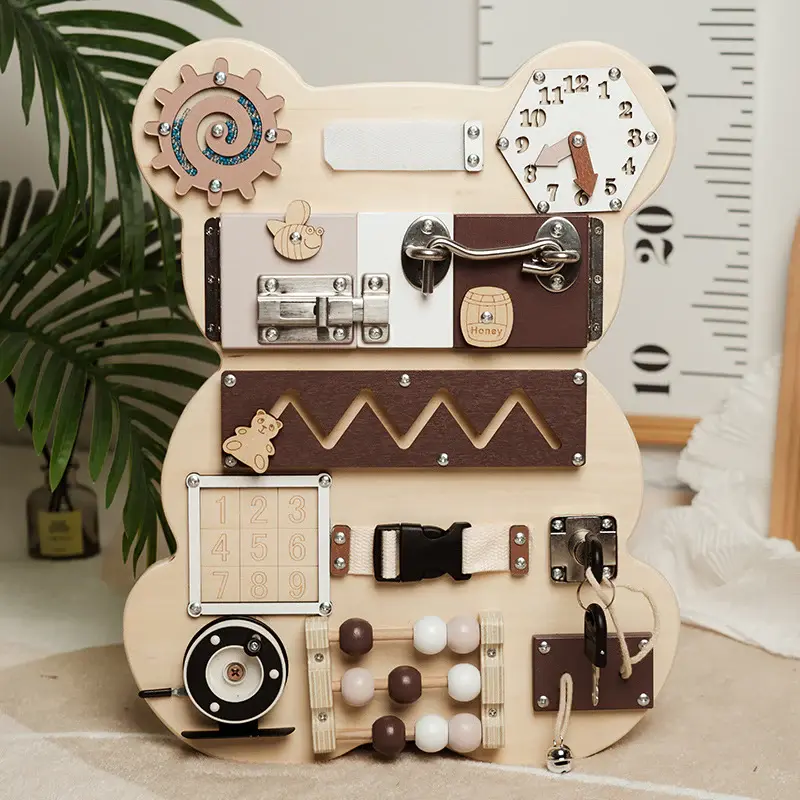
Wooden Toys vs Plastic: An Honest Guide for Parents
Walk down any toy aisle and you'll face the same quiet decision over and over: the wooden version or the plastic one? The wooden toys vs plastic debate has been running for decades, and it tends to generate more heat than light — wood gets romanticized, plastic gets demonized, and parents are left wondering whether any of it actually matters for their child. It does. But not always in the ways the marketing suggests. Here's an honest look at where the differences are real, where they're overstated, and how to decide what earns a place in your home.
Wooden Toys vs Plastic: The Sensory Difference Is Real
Pick up a solid beech stacking ring and a hollow plastic one, and your hands know the difference instantly. The wooden ring has heft. It feels cool at first touch, then warms in your palm. Its surface carries subtle grain and texture. When it knocks against another ring, the sound is a soft clack rather than a sharp rattle.
For adults, these are aesthetic preferences. For babies and toddlers, they're information. Young children build their understanding of the physical world through their senses, and richer sensory input means richer learning. A toy with real weight teaches something true about how objects behave: it takes effort to lift, lands with a satisfying thud, and demands steady hands to balance. That honest feedback is part of why a simple stacker like our Rainbow Stacking Tower holds attention so well — the toy responds to what the child does, not the other way around.
Plastic, by contrast, tends to be uniform: same temperature, same smoothness, same negligible weight whether the toy is a block or a truck. None of this makes plastic harmful. It just makes it less interesting to small hands that are doing serious research.
Durability: The Buy-It-Once Argument
A well-made hardwood toy is hard to kill. Drop it down the stairs and you get a dent that adds character. Chew on it, leave it in the toy bin for a decade, hand it to a younger sibling — it keeps working. When the finish wears, it can often be sanded and refreshed, and a clean break can frequently be repaired with wood glue.
Plastic toys fail differently. The body may survive, but the weakest points — battery doors, hinges, snap-fit joints, thin handles — crack first, and a cracked plastic toy is usually finished. There's no sanding it down, and sharp broken edges turn a toy into a hazard overnight.
Fairness requires a caveat: good plastic exists. Classic interlocking bricks get handed down for generations, and a sturdy plastic bucket will outlive us all. The durability gap is widest at the cheap end of the market, where thin-walled toys are effectively designed to be discarded. With wood, even mid-priced toys tend to last — it's why pretend-play staples like a wooden play kitchen are often still in service when their first owner has long outgrown them. They're built like furniture, not packaging.
What Research Says About Electronic Toys and Language
The sharpest evidence in this debate isn't really about wood versus plastic at all — it's about toys that talk versus toys that don't.
A study published in JAMA Pediatrics recorded parents playing with their infants using electronic toys, traditional toys, and books. During play with electronic toys, parents said fewer words, responded to their children less often, and the back-and-forth conversational turns that drive language development dropped measurably. The pattern makes intuitive sense: when the toy is doing the talking, the adults go quiet — and it's the adult's voice, not the toy's, that builds vocabulary.
The American Academy of Pediatrics has made a similar point in its guidance on choosing toys, steering families toward traditional toys that promote caregiver-child interaction and noting that lights, sounds, and digital features can get in the way of the social exchange young children need most.
This doesn't mean an electronic toy will harm your child. It means the "educational" claims on the box deserve skepticism — and that a silent toy that pulls a parent into the play is doing more for language than a toy that sings the alphabet on its own.
Safety: A More Honest Comparison
This is where wooden-toy marketing tends to overreach, so let's be precise.
Plastic toys legally sold in the U.S. must meet the ASTM F963 safety standard, and federal law restricts lead and several phthalates in children's products. A name-brand plastic toy bought new from a reputable retailer is, in regulatory terms, a safe product. The genuine plastic-related risks sit elsewhere: very old hand-me-downs made before modern phthalate restrictions, unbranded marketplace toys that may never have been tested, and broken plastic with sharp edges.
Wooden toys have their own checklist. Look for a hardwood like beech or maple (softwoods dent and splinter more easily), and a non-toxic, water-based finish — especially important for anything headed straight to the mouth, like a teether. And small-parts rules apply exactly as they do for plastic: a wooden bead is just as much a choking hazard as a plastic one.
One quieter point in wood's favor: some research suggests wood surfaces are naturally less hospitable to bacteria than plastic ones — it's part of why wooden cutting boards have held their own in food-safety studies. That's no excuse to skip cleaning toys, but it's a pleasant property in an object that lives on the floor.
The Sustainability Question
Here the gap is harder to argue away. Wood is renewable, stores carbon while it grows, and biodegrades when its useful life ends; responsibly managed forestry (look for FSC certification on packaging) makes it one of the more defensible materials in your house. Plastic is made from fossil fuels, and toys are among the hardest plastic products to recycle — they're typically mixed polymers, often fused with metal, fabric, and electronics, so nearly all of them end up in landfill.
That said, the greenest toy is the one that gets used longest, whatever it's made of. A plastic toy passed through three children beats a wooden toy gathering dust on a shelf, and buying secondhand beats buying new in either material. Sustainability is as much about buying less and choosing well as it is about the material itself.
The Practical Verdict
You don't have to pick a side. A reasonable approach for most families:
- Make wood the default for the everyday core. Blocks, stackers, puzzles, pretend play — the toys handled hundreds of times a week are where sensory quality and durability pay off most.
- Be choosy, not absolutist, about plastic. Buy new or from sources you trust, favor sturdy open-ended designs, and retire anything cracked.
- Treat electronic toys as occasional, not foundational. Especially under age three, the research points firmly toward toys that leave room for your voice.
- Buy fewer, better things. A small shelf of well-chosen toys gets played with more deeply than an overflowing bin — and holds its value as a hand-me-down.
If you're starting fresh or shopping for a gift, our age-based gift guide breaks down which toys earn their keep at every stage — no batteries required.