Play Ideas
15 Screen-Free Play Ideas for Every Age (0–5 Years)
Little Genius Team7 min read
We get it — screens are easy. But the research is clear: young children learn best through hands-on, interactive play. Here are 15 screen-free play ideas organized by developmental stage.
Newborns & Young Babies (0–6 months)
- High-contrast cards: Newborns can only see about 8–12 inches away, and they're drawn to bold black-and-white patterns. Prop cards near their play mat during tummy time.
- Sensory scarves: Drape lightweight silk scarves over a baby gym. The gentle movement and texture fascinate developing eyes and grasping hands.
- Wooden rattle exploration: Once baby can grasp (around 3–4 months), a simple wooden rattle introduces cause and effect. "I shake, it makes sound!"
Older Babies (6–12 months)
- Object permanence box: Drop the ball in, it disappears, it comes back. This simple toy helps babies understand that objects exist even when hidden — a huge cognitive milestone.
- Nesting cups: Stack, nest, pour, bang together. One toy, endless play patterns. Great for early problem-solving.
- Treasure basket: Fill a basket with safe household objects of different textures — a wooden spoon, a silk scarf, a metal whisk, a rubber ball. Let baby explore freely.
Young Toddlers (1–2 years)
- Shape sorting: The classic for a reason. Matching shapes to holes builds spatial reasoning and fine motor control.
- Stacking rings: Ordering by size teaches sequencing. Knocking them down teaches cause and effect (and is deeply satisfying).
- Water play: A shallow bin with cups, funnels, and spoons. Pouring and scooping build hand-eye coordination and introduce early math concepts (full, empty, more, less).
Active Toddlers (2–3 years)
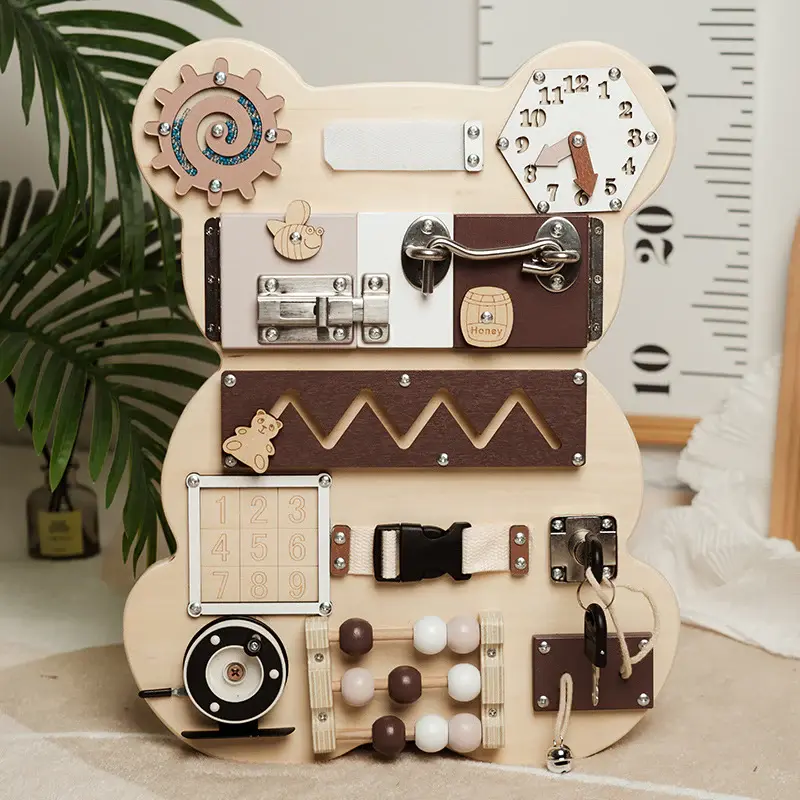
- Busy board exploration: Latches, locks, switches, and zippers on a board. Endlessly engaging for toddlers who want to figure out how things work.
- Play dough and tools: Rolling, cutting, squishing — play dough is a sensory powerhouse that builds hand strength for future writing.
- Simple puzzles: Knob puzzles (3–5 pieces) for younger toddlers, jigsaw puzzles (6–12 pieces) as they advance.
Preschoolers (3–5 years)
- Open-ended building: Blocks, magnetic tiles, or wooden planks. The only limit is imagination. Builds spatial reasoning, engineering thinking, and collaborative play.
- Pretend play kitchen: Cooking, serving, and cleaning up build social skills, vocabulary, and sequencing (first we chop, then we stir, then we serve).
- Nature collection walks: Bring a bag on walks and collect leaves, rocks, sticks, and flowers. Sort them at home by color, size, or type. Free, screen-free, and rich in learning.
The Best Toy? Your Attention.
None of these require expensive equipment. The most powerful "toy" in your child's world is an engaged adult who follows their lead, narrates their play, and celebrates their discoveries.
Browse our full collection for toys that support every stage of this journey.
#screen-free#play-ideas#activities#child-development