Busy Board Benefits for Toddlers: What Every Latch, Zipper, and Gear Actually Teaches
Watch a toddler near a door latch, a light switch, or the buckle on their own stroller and you will see it: an almost gravitational pull toward anything that clicks, flips, or fastens. A busy board channels that obsession into safe, repeatable practice — and the benefits of a busy board for toddlers go far deeper than keeping small hands occupied. Every latch, zipper, and gear on a well-made board is a miniature lesson in fine motor control, problem-solving, and growing independence. Here is what each element actually teaches, when your child is ready for it, and how to spot a board that is worth the money.
Why Toddlers Are Drawn to Hardware
Montessori educators describe the toddler years as a sensitive period for practical life — a window when children are intensely motivated to do real things with real objects. Between roughly one and three, your child wants to do the things they watch you do dozens of times a day: open doors, fasten buckles, flip switches, zip jackets. The fascination with your keys and the dishwasher latch is not random. It is purposeful practice.
A busy board honors that drive instead of redirecting it. Rather than a toy that merely imitates the adult world, it puts real hardware at child height — actual metal latches, working zippers, gears that genuinely mesh. The child gets to practice on their own terms, the several hundred times mastery requires, without anyone hovering nervously near the front door deadbolt.
The Benefits of a Busy Board for Toddlers, Element by Element
Not every activity on a busy board teaches the same thing. Here is what each common element is quietly working on:
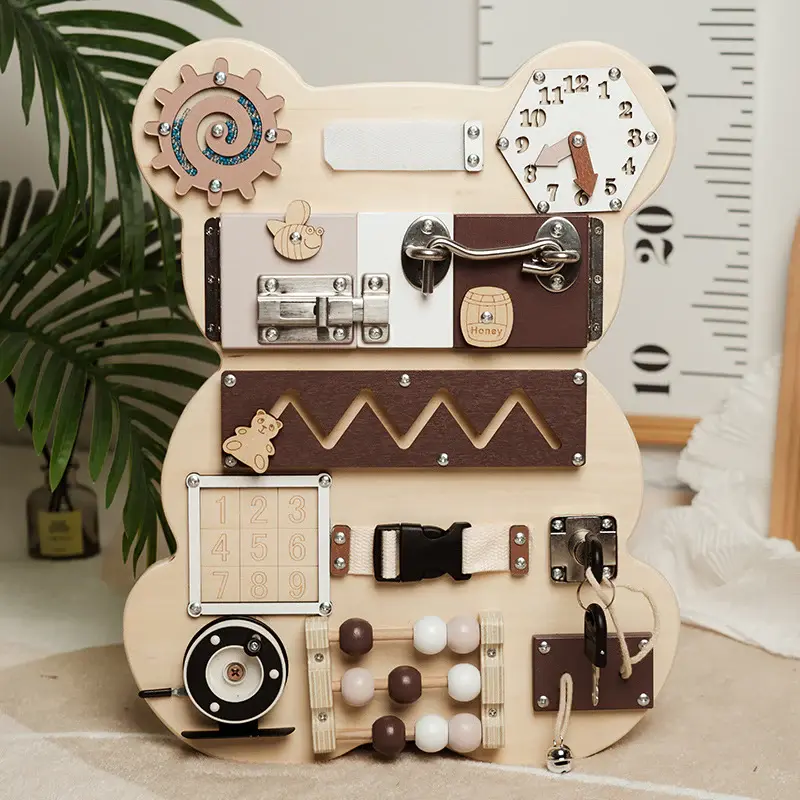
- Latches and locks — Two-step problem solving and sequencing: lift, then slide; turn, then pull. Each latch type also demands a different grip — a hook-and-eye works the pincer grasp, a sliding bolt builds wrist rotation, a barrel lock requires finger strength. Variety here is a feature, not decoration.
- Zippers — Bilateral coordination, meaning both hands working together at different jobs: one hand stabilizes the fabric while the other pulls. This is the same skill your child needs to dress themselves, which makes the zipper one of the most directly practical elements on any board.
- Gears — Cause and effect at a mechanical level. Turning one gear and watching its neighbor move is early physics, and the whole-wrist rotation involved supports later tool use — spoons, crayons, toothbrushes.
- Switches and buttons — Finger isolation: pressing with one finger while the others stay still. It sounds trivial, but it is genuinely hard for toddlers, and it underpins pointing, counting on fingers, and eventually a proper pencil grip.
- Buckles — Controlled squeeze-and-release force with both hands mirroring each other. The payoff shows up in car seats and high chairs, where a child who can work their own buckle (under supervision) feels enormously capable.
- Doors and hinges — Object permanence and anticipation. A small door rewards a full sequence — unlatch, open, peek, close — and the hidden picture behind it keeps the discovery loop satisfying long after the mechanism itself is mastered.
Underneath all of these sits the same core work: refining the small muscles of the hands and fingers while connecting actions to outcomes. Occupational therapists often recommend exactly these kinds of manipulation tasks to build the hand strength and dexterity that handwriting will eventually demand.
What Age Suits a Busy Board?
Most busy boards are recommended for roughly ages one to four, but the way a child uses one changes dramatically across that span:
- 12–18 months: Expect banging, flipping, and spinning. Simple cause-and-effect elements — switches, spinners, doors — get the most attention, while latches mostly get rattled rather than opened. That is fine; rattling is research. Supervise closely at this stage, especially with any board that carries a small-parts warning.
- 18 months – 2.5 years: The sweet spot. Persistence arrives, and children begin deliberately working latches and zippers, repeating each one until it yields. This is when you will see the longest stretches of focused, independent play — and when the board earns its place.
- 3–4 years: Mastery and speed. Older toddlers chain elements together, race themselves, and narrate what they are doing. When every element becomes easy, interest naturally fades. That is not a failure — it is the board telling you its work is done.
How to Choose a Quality Busy Board
Busy boards range from beautifully built to genuinely hazardous, and product photos rarely tell you which is which. Use this checklist:
- Securely fastened hardware. Every element should be screwed in, not glued, and nothing should work loose under determined toddler force. Small metal parts that detach are the single biggest hazard on a cheaply made board.
- Smooth, solid wood. Birch plywood and hardwoods sand to a smooth edge and hold screws firmly over years of yanking. Check for rounded corners and splinter-free surfaces.
- A non-toxic finish. Look for a water-based sealant or natural oil. Toddlers will mouth the board at some point — assume it, and choose accordingly.
- Safety testing you can verify. Favor boards tested to recognized standards such as ASTM F963 or EN71, and take the stated age range and small-parts warnings seriously rather than rounding down.
- A range of difficulty. A good board includes elements your child can manage today and elements they will grow into. That is the difference between two years of use and two weeks.
- Real materials over imitations. A metal latch has a weight and a click that plastic cannot replicate, and that richer sensory feedback is part of what holds a toddler's attention.
Our Wooden Bear Busy Board checks every box on this list — a dozen hands-on activities in solid wood with sourcing to meet ASTM F963 and EN71 standards, suited to ages one to four. You can compare it against the rest of our busy board collection to find the right fit for your child.
A Quiet Word About Expectations
A busy board will not buy you an hour of silence every day, and any product promising that is overselling. What it will reliably give you is ten- to twenty-minute stretches of deeply focused, self-directed play — and in toddler terms, that is remarkable. Concentration is built in exactly these increments.
It also earns its keep in specific moments: restaurant tables, waiting rooms, long car rides, the stretch before dinner. A board that travels well can be the difference between a meltdown and a manageable afternoon.
And if you are shopping for someone else's child, a busy board hits a rare sweet spot — substantial enough to feel like a real gift, useful enough to be played with for years. Our age-based gift guide can help you match a board, or any other toy, to exactly the stage a child is in.